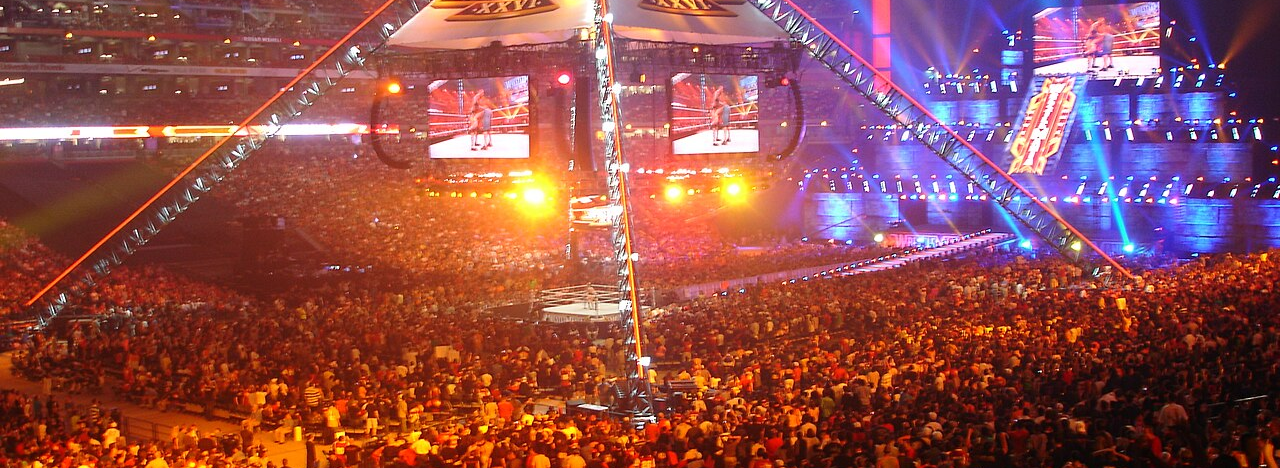
Let’s talk about belief and community. I want to sketch out the mechanism by which belief operates as a social force in a community-slash-society. I’m not in a poetic mood today, so I’ll just go ahead and say that I’m going to use two basic examples: religion and pro wrestling. This is likely to be a pretty brief sketch but I expect to use it more later.
To begin with, we have to nail down what we mean by belief. In terms of religion, “belief” as a phenomenon comes to have a certain meaning: “belief” means something like “knowledge of and reliance upon a certain idea”. That was off the top. Just for reference, Collins Dictionary says belief is “a feeling of certainty that something exists, is true, or is good”, among other definitions.
Proving that belief really exists is beyond the scope of this piece; that’s a concern for psychology and neurology. But it is a social fact that belief exists, so we’ll take it as read that there is such a thing as believing that people can do, and that people can believe in anything, whether it is really true or not. That is to say, while the fact of believing in something means that the believer knows and feels that something to be true, that something does not have to lead to or make up a testable truth.
The question I am trying to answer by sketching out this structure of belief is, in broad, how belief operates. In specific, there are two questions: first, what does it mean to say ‘so-and-so believes in this’?; and second, how can people sustain a belief in something despite rejecting some of that thing’s components?
In religious terms, this could be summed up in questions like “what makes a lapsed Catholic still Catholic?” or “why do people who commit sins still call themselves religious?” This sketch isn’t intended to explain the full breadth of these questions, only to provide a skeleton for understanding the structure of belief.
I believe that belief, as a social force, has three components: the idea, or the thing which is believed in; the set of primary believers; and the set of secondary believers. The concept of the idea should be simple enough to grasp, given how I’ve already defined belief itself. It’s the difference between primary and secondary believers which is important.
I imagine that it’s possible to figure out what I’m going to say here just by introducing the concept, but I should draw out the connection anyway. Primary believers are those who actually believe in the central idea. In terms of religion, there are many types of primary believers. Obviously, there are those who we might call “true believers”: regular people who simply believe wholeheartedly in the message of their religion. Also among the primary believers are saints and blessed mortals, as well as the figures of religious narratives. Mystics are also among the true believers. These types of people do not have a metaphorical belief. Though they do not all believe in the supernatural as-such (that is to say, in the appearance of otherworldly beings, working of visible wonders, etc.), the religious belief they have is real and direct.
While I acknowledge this is somewhat blasphemous to suggest, I believe that in most religious communities, most people are secondary believers. The distinction between primary and secondary believers is not that secondary believers disbelieve the central idea but that the evidence that secondary believers rely on is not the central idea itself or any of its components; secondary believers rely upon the belief of primary believers. While I have introduced belief with religion, I think a clearer example here is actually in science, as people can easily see that they are secondary believers in the majority of scientific topics. For instance, we can look up the fact that the speed of light is 299,792,458 meters per second. But how many of us have conducted experiments showing that speed, and deriving the figure for ourselves? In general, we rely on the fact that other people have done it, and that they believe in the figures that they publish.
A similar phenomenon happens in religions. We can evidence this in the basic division between the sanctified – priests, monks, wonder-workers, etc. – and the lay people. Lay people, by and large, are secondary believers, and they rely upon the primary believers who are sanctified to demonstrate the proper way to express their belief.
However, this distinction is not clear-cut. There are lay people whose religious belief is powerful and there are priests who barely take their duties seriously. In fact, an individual could only say for themselves whether they are a primary or secondary believers, and many would not actually be able to decide. Community and belief are inextricably bound up, from the Buddist Sangha to the Islamic Ummah. Yet we do have to identify that not everyone’s belief is the same: some actually follow the religion as they see it while some rely upon the fact that others are following the religion. Is the belief of a secondary believer less than that of a primary believer? Yes in one sense, but in another sense they are equal, or rather, the strength of belief does not depend on the position of belief.
Pro wrestling can help us to understand an essential element which it is harder to explain through religion or science: the idea of primary believers as a concept. Despite my conclusion about the strength of belief, it can’t be ignored that in many cases, it will naturally seem that the primary believers are the most devoted believers. The example of pro wrestling will help complicate this picture in a way which I find useful for putting on the brakes on interpretations of primary and secondary which are too absolute.
If you are not familiar with pro wrestling, in short, they are staged fights which are put on for entertainment. I’ve written a decent amount on the distinction between wrestling and theater, but for our purposes now, it is acceptable to view wrestling as a kind of theater. That is to say: it is an entertainment, a show, and it requires suspension of disbelief in some measure. You are supposed to buy into the idea that this is a real contest, no matter what outlandish moves or other events take place.
The reality is, despite bloviating about kayfabe (maintaining the pretense of reality) and the incredible showmanship of days gone by, most people always knew that pro wrestling was staged. If you look in the newspapers of the 20s and 30s, it was a common topic. The idea of the “death of kayfabe” is really just a marketic ploy. I don’t want to get into it too far.
What I’m getting at is that if we take the idea of pro wrestling being real as the central idea, it would seem that there were rarely ever (or perhaps never) any actually primary believers in this idea. Of course, this is never strictly true, as many children do actually believe pro wrestling is real until they get old enough (either for someone to tell them or for them to figure it out by simply watching), but the idea that a crowd of adult pro wrestling fans would mainly be believers in the show is ridiculous. It is ahistorical.
However, it is not accurate to say that the interaction with pro wrestling is based on the fact that the proceedings are unreal. This is one of the major distinctions between pro wrestling and theater, and especially cinema. The actions of a theater villain are primarily analyzed by viewers on their own terms. A viewer who does not find a killer frightening, for instance, is not necessarily asked to find the killer in a play or movie frightening; they are allowed to experience the play how they want, and focus on other aspects which may be interesting to them.
It should be clear that what I’m talking about is a particular conception of pro wrestling, specifically that adopted in North America and Western Europe, but this essay is about belief and not wrestling, so this is well enough. This pro wrestling is unlike theater in that it does construct an ideal viewer. There are rules to be followed, and the adherence to (or breaking of) rules is the central personal drama in pro wrestling. The one who sticks to “the right path” and fights within the rules is to be lauded, while the one who takes the easy way and cheats is to be despised. You are meant to view wrestling through this lens. The villain must be evil.
I hate Jon Jones, the MMA fighter, with my entire life. I think he’s one of the dirtiest fighters there has ever been, I think he’s garbage as a person, and I think any accomplishments he’s gained are marred by the fact that it sucks to watch him fight let alone win. I hate Conor McGregor, who’s less dirty of a fighter but maybe worse as a person. But those are two of the biggest stars in MMA history. The people who I preferred over them – Daniel Cormier who got beat by Jones, Khabib Nurmagomedov who destroyed McGregor – meant a fraction as much as they did for the business and popularity of MMA. I bring this up to say that the idea that everyone naturally values the things that pro wrestling presents is false. These aren’t innate values that people naturally gravitate towards. These values are constructed through the ideal viewer.
To bring this back to terms of belief, what this implies for pro wrestling is that it is almost entirely secondary believers with no primary believers. Again, this isn’t strictly true, but it’s near enough. In the case of children, the moral weight given to children’s decisions is minuscule; there is almost nothing on which children are believed over adults (unfortunately even running to children’s own well-being). I don’t believe that the idea that children believe wrestling is real could sustain the secondary belief of wrestling fans on its own.
Rather, I think that wrestling fans have an imagined primary believer who has truly bought into the show of pro wrestling, and it is the notion that this person exists which allows them to buy in as well. It isn’t that the behavior necessarily bothers each individual viewer, but the behavior would bother the ideal wrestling viewer, and it is from that which the wrestling fans take their cues.
This implies two things about belief. First, and most obvious, belief does not require an actually existing primary believer, only the ability to believe in a primary believer. If wrestling tried to base itself on the idea that breaking the rules is good that would not work because people would not associate that with any kind of effort in restraint (unless the rules were considered immoral or unjust which means, in other words, that the rules themselves are in violation of higher rules).
It isn’t the case that wrestling demands its viewers adhere to the presented belief structure, it’s that the thing presented – the show formatted as matches with rules leading to prizes – allows viewers to construct that image, and then makes situations which reinforce that image. A decent wrestling promotion does not need to put up an “Applause” sign for the audience (I’ve never heard of this happening but we’ve gotten pretty close). It simply lays out its setting, and then tends to make heroic characters the ones who adhere to the rules while making despicable characters the ones who break them.
The second thing that the imagined primary believer implies is that the idea of a “true belief” which is “unmediated” is a construction. While we can create this structure which divides primary and secondary belief, no side’s belief is “the real belief”. After all, a scientist might make an observation, but unless that observation could be corroborated by others and used by still more, it couldn’t be considered a “fact” that other people believe in. Belief might have primary and secondary stages but, as a phenomenon, the stages are self-reinforcing. While it’s true that I’ve demonstrated there may be secondary believers without an actual primary believer, there could not be a secondary believer without at least an imagined primary believer. I have already explained the opposite situation.
I think that’s all I have to say for now.
Comments
One response to “Circles of Belief”
[…] now are too soft for MJF’s type of material and partly because I’ve recently written a piece about circles of belief which I feel can be applied […]